

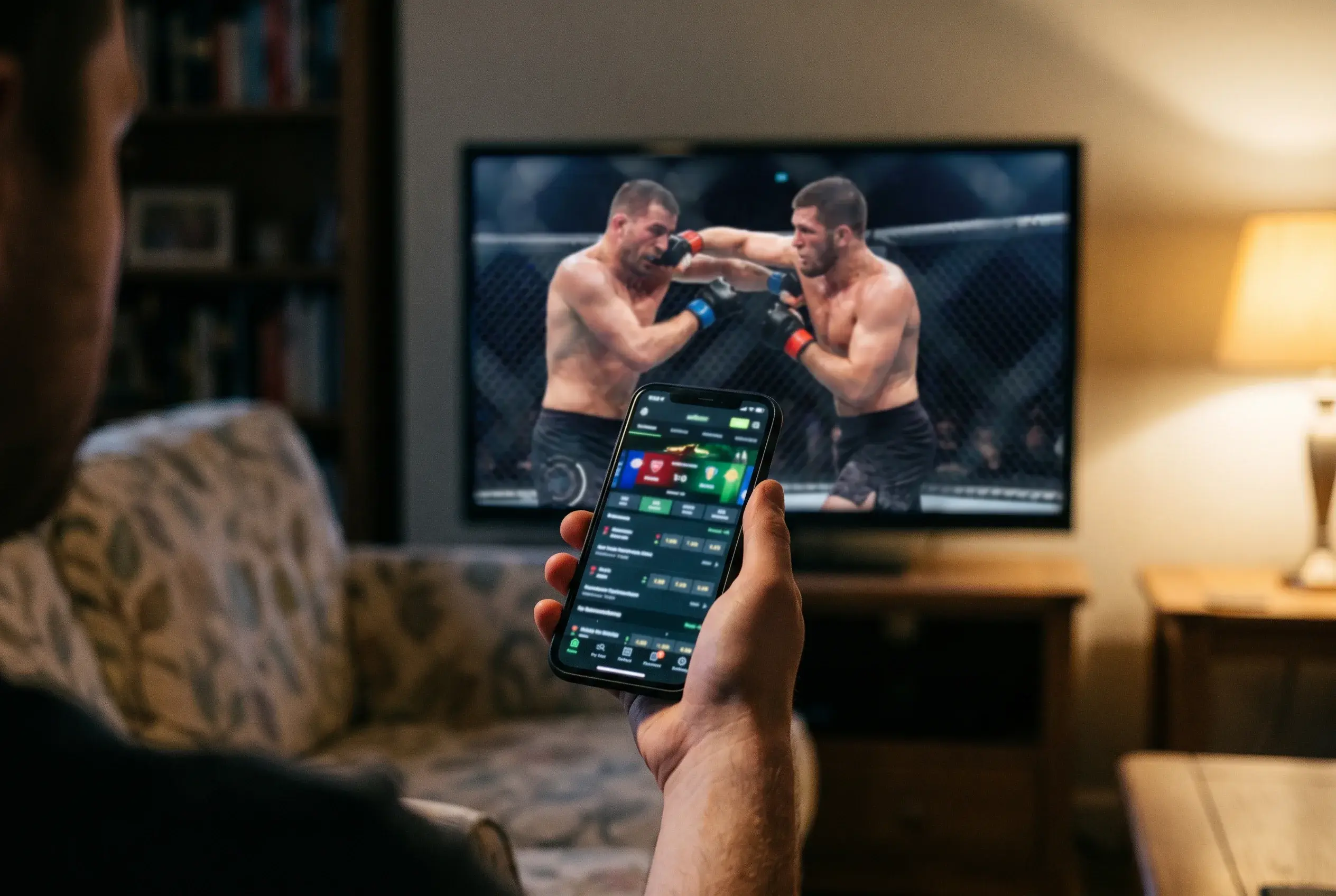
Live betting is not an information advantage
The first time I tried to bet live on a UFC card, I was sitting on my sofa with the PPV stream running, watching what I thought was the current state of the fight, and the line on my screen kept moving in ways that made no sense to me. It made perfect sense. The fight had moved on by several seconds before what I was seeing reached my screen — and the book had updated its line to reflect what was happening live in the arena. I was placing bets on the past.
Live betting on UFC is sensitive to broadcast delay in a way that most casual bettors do not appreciate until they start losing money to it. It is not an edge built on speed. For the typical viewer at home, it is structurally an informational handicap. The book has a faster feed than your stream. Whatever you are reacting to has already updated the line — and often the line has moved past the value you think you spotted. Working with that limitation is the first rule of live betting on UFC.
See also: total rounds betting in UFC as a live market.
How live markets actually build
A live UFC betting market is reconstructed from scratch every few seconds during a fight. The book runs a model that ingests round score predictions, damage assessments from the live arena feed, and judge-card probabilities, and outputs new prices on the moneyline, round totals, distance, and various live props. The cycle is fast — typically every 10 to 20 seconds during active fight action — and the price reset takes effect on the bettor’s interface in near real time.
The data feeding the model is not what you see on your stream. The book has access to an arena-direct feed with minimal latency, sometimes supplemented by an on-site analyst flagging events for the model in cases where the feed alone is insufficient — a knockdown the camera angle missed, a corner instruction overheard at the cage. The model output is updated lines, and the lines move before the bettor at home sees the action that drove them.
What this means in practice is that the “spike” in price you see after a knockdown is not value — it is the book correcting after information you already received delayed. If you saw the knockdown on your stream, the book saw it three to seven seconds earlier and has already repriced. The line you are betting into at that moment is already reflecting the new reality. The only situations where the public live bettor has an information edge are situations where the book’s model has lagged its own data — and those are rare and short-lived.
The implication is that good live UFC betting is not a game of reaction speed. It is a game of pre-set price targets. You know in advance what price you would be willing to bet on a specific fighter mid-fight conditional on certain events, and you place the bet only if the offered price exceeds your pre-set threshold. The model in your head moves before the action, not after it.
Broadcast delay as a real cost
The exact magnitude of broadcast delay varies, but the working numbers are consistent. A UFC PPV stream delivered to a US home over a streaming service typically runs 30 to 60 seconds behind the live arena action. Cable or satellite delivery can be slightly tighter, but only marginally — modern broadcast infrastructure inserts processing delay that almost no consumer feed escapes.
The book’s feed is not subject to the same delay. Books with live UFC trading desks operate on direct arena feeds with end-to-end latency typically under two seconds. The gap between what the book is pricing on and what the home bettor is reacting to is therefore in the region of 28 to 58 seconds. In a five-minute round, that is meaningful — entire exchanges, takedown sequences and corner instructions can happen and be priced in before the home viewer sees them begin.
The practical advice that follows is unglamorous. If you are going to bet live UFC from a home stream, treat any price that has just moved sharply as already reflecting information you do not have. Do not chase the move; do not assume the new price is mispriced just because it looks attractive. The book has priced it deliberately and is willing to take action at that price because it has more information than you do. The only live bets worth placing under those conditions are bets where you have a structural read independent of the broadcast — pacing tells, late-fight conditioning expectations, end-of-round momentum patterns — and where the offered price exceeds your pre-set threshold.
Suspension windows
Between rounds, and during certain in-fight events, books suspend the live market. The market goes dark — no bets accepted, prices frozen. The duration of suspension varies but typically runs from the end of one round through the first 30 seconds of the next, and reactivates after the round is well underway.
Suspension serves two purposes for the book. First, it gives the trading desk time to reprice the market against the score of the previous round and the damage assessment. Second, it prevents bettors from placing bets during the most information-asymmetric window of the fight — the seconds immediately after the round bell when corner footage, replays, and slow-motion damage assessment are visible and pricing has not yet caught up.
From the bettor’s perspective, suspension windows have one useful implication: the market that comes back online after a suspension is more efficiently priced than the market that went dark. Trying to time the reopening to catch a specific price is generally a losing strategy because the book has used the suspension specifically to remove the price you wanted. The market that returns reflects the book’s full reassessment, and the bettor who plans around suspension cycles is better off treating the first 30 seconds of a new round as a wait-and-see period rather than an active bet window.
Cash-out mathematics
Cash-out is the feature books offer that lets you settle a live bet before the final outcome — taking a reduced payout in exchange for locking in some return rather than risking a full loss. It is marketed as a convenience and a way to “secure your winnings”. The mathematics make a more skeptical assessment.
A cash-out offer is calculated by the book as the current implied probability of your bet winning, multiplied by the original potential payout, minus the book’s cash-out margin. The cash-out margin is the book’s profit on the early settlement, and it is typically 5% to 10% — sometimes higher on live markets. The cash-out value is therefore systematically less than the fair settlement value of your bet at that moment.
The implication is that taking cash-out is mathematically equivalent to paying additional juice on the original bet at the time of settlement. If your bet was at +200 originally and the current fair value is +150, the cash-out offer reflects approximately +160 to +175 — meaningfully less than fair value. Doing this once or twice has minor impact. Doing it routinely is paying double juice on every live bet you settle this way, on top of the juice already embedded in the original price.
The only situations where cash-out math works in your favour are situations where the book’s cash-out algorithm has lagged or where a promotional offer caps the margin. Those are rare. The default assumption should be that cash-out is a paid convenience, not a value extraction. If your original bet has a positive expected value at the time of placement, holding to settlement preserves that expected value; cashing out trades it for certainty at a cost.
See also: how to bet on ufc in california — live betting.
Micro-markets and the temptation problem
The newest layer in live UFC betting is the micro-market — bets on outcomes within the next minute, the next strike sequence, the next takedown attempt. These markets are aggressively pushed during live broadcasts because they convert spectator attention into transaction volume on the fastest possible cycle.
The math on micro-markets is even less friendly than on conventional live markets. The book’s hold on micro-markets is wider, often 8% to 12% per bet, because the modelling is harder and the volume is lower. The latency disadvantage for the home viewer is more severe — a “next minute” market resolves before the broadcast delay has even elapsed, in some cases. And the cycle of bets is fast enough that bettors who engage with micro-markets routinely place multiple bets per fight, multiplying the juice impact across an evening.
The discipline against micro-market temptation is the same discipline as against any in-fight impulse betting: pre-set price targets, no reactive placements based on what just happened on screen, and a hard cap on the share of bankroll exposed live in any single fight. For anyone working through the full range of UFC bet types and where each lives on the risk-reward spectrum, micro-markets sit firmly in the high-juice, low-edge corner. They are entertainment products dressed as betting opportunities. Treating them as the latter is where bankrolls evaporate the fastest.