

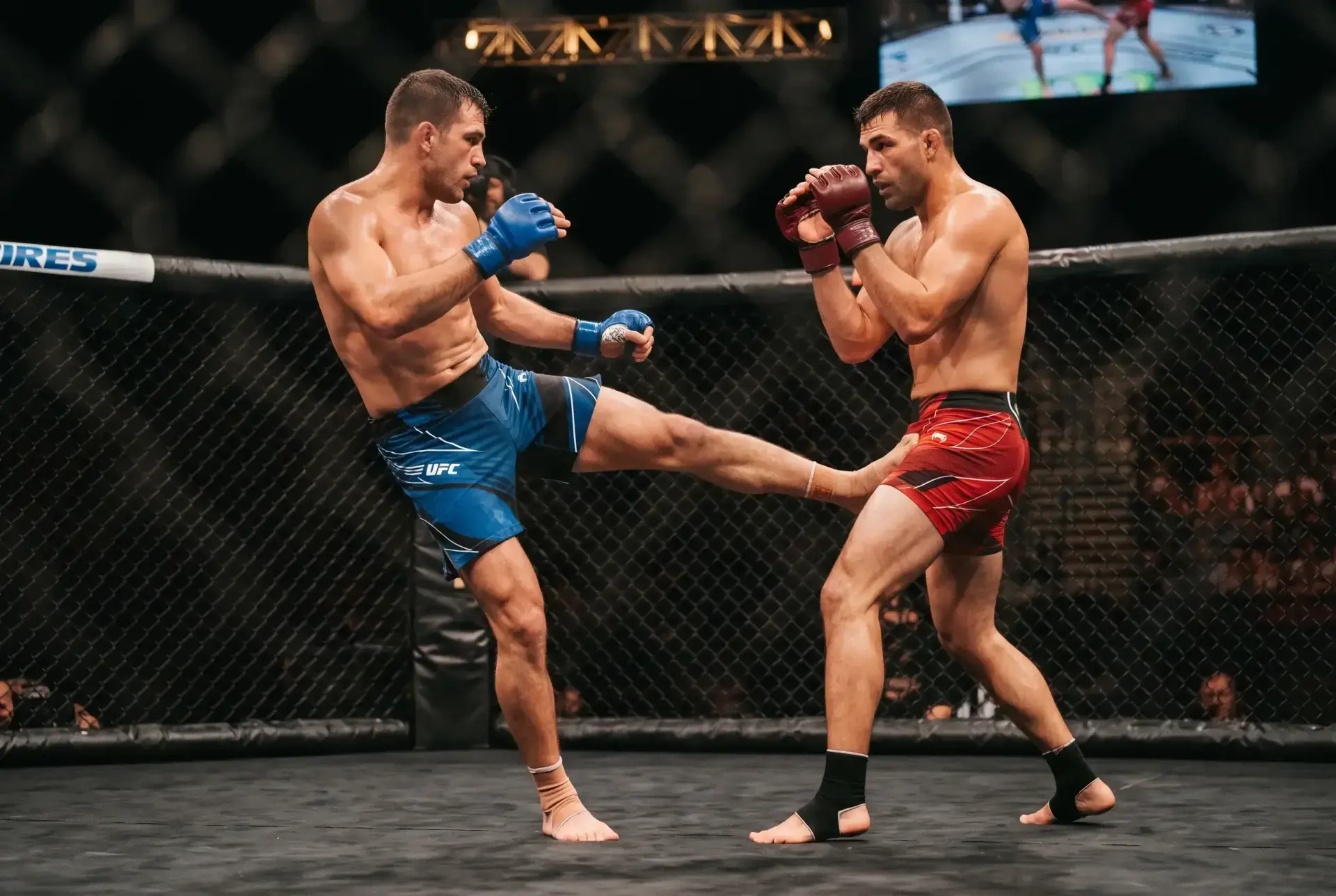
Why UFC Markets Refuse to Behave Like Football
The first UFC ticket I ever logged for analysis was a Stockton lightweight at +145. The bookmaker had moved the line twelve hours before the open and the close came in at +118. Inside that single line move was every reason UFC markets feel different from team sports — short rosters, asymmetric information, public money pinned to a single fighter, and a market that has to do all its price discovery in a forty-eight hour window instead of over a six-month season.
This piece is the walkthrough I wish someone had handed me eight years ago. Every UFC bet type, mapped to how the line is actually built, what it pays, where the bookmaker’s edge sits, and which version is a product to play and which version is a product to skip. I am writing in pounds and American odds because that is the market a California-facing or UK-facing reader will encounter on every offshore platform that takes their action. The MMA handle in 2024 reached $10.3 billion globally, up 17% year-on-year — meaningful enough that bookmakers now build genuine bespoke models for UFC rather than recycling boxing pricing. That maturity changes what an attentive bettor can actually exploit.
A note on what this piece is not. It is not a “which book is best” comparison. It is not a parlay-of-the-week column. It is a structural primer on what each market type does, written by someone who has shopped lines through several offshore generations and watched plenty of bettors discover that the friendly +185 dog was being offered for a reason. Where the deeper line-reading mechanics belong in a separate article, I will point there — particularly to the American odds primer for the basics of plus/minus notation.
See also: reading American odds for MMA to understand the lines.
Moneylines: The Spine of Every UFC Card
Three years ago a reader asked me why UFC moneylines look so much heavier than the moneylines on NFL games. He had seen Islam Makhachev at -650 and was certain the line was wrong. It wasn’t. It was just doing what UFC lines do when the market believes a fight is structurally non-competitive: it goes to a place that makes laying odds feel obscene, because in MMA the variance on a single fight is so wide that even -650 leaves the house with margin.
The moneyline in UFC asks one question. Who wins? No spread, no draw most of the time, no asterisks beyond the rare technical decision. The two sides are priced in American odds — a minus number on the favourite, a plus number on the dog. A -200 favourite implies you must risk £200 to win £100. A +175 dog implies £100 risked returns £175 in profit if the fight goes your way. The implied probability of -200 is roughly 66.7%, and of +175 about 36.4%. Add those together and you get over 100% — that excess is the bookmaker’s hold, also called vig or juice. In UFC, hold tends to run 4% to 8% on main-card lines and can climb above 10% on prelims with limited liquidity.
UFC has no point spread in the team-sport sense because there is no incremental scoring to spread. A handicap product does exist in some markets — a “fighter A wins by KO/TKO or submission” version that prices roughly like a spread — but it is not the workhorse market. The workhorse is the binary moneyline. That binary structure is also why UFC lines move violently. A team-sport line can absorb a sharp player without moving more than half a point. A UFC line, particularly on prelims or contender-series cards, can leap thirty or forty cents on a single five-figure bet because the bookmaker has thinner inventory to defend the price.
Reading the close is the single most useful habit a UFC bettor can develop. The closing line — the final price the book is offering when the fight starts — is the market’s best aggregated guess. If you regularly bet a side at numbers worse than the close, the market is telling you something. If you regularly bet a side at numbers better than the close, you are picking off slow lines and your model is doing real work. Closing line value is the audit that separates analytical bettors from confident ones.
One thing the moneyline does not tell you, no matter how carefully you read it, is how the fight is going to be won. Two fighters can be priced at the same -180 / +155 line but live in completely different stylistic universes. That is what method of victory is for, and it is the market where MMA betting actually starts to get interesting.
Method of Victory: Where MMA Pricing Becomes Genuinely Bespoke
A friend who books bet markets at a smallish offshore operation told me, over a coffee in a London airport, that method of victory was the market that got him his first promotion. He had built a model that priced KO, submission, and decision separately and the head trader could see his hold widen on every fight he covered. The reason method of victory is interesting is that it forces the bookmaker — and the bettor — to commit to a view about how the fight ends, not just who wins.
The three default branches are knockout/technical knockout, submission, and decision. Some books split decision further into unanimous, split, and majority; the more granular the split, the higher the hold, because each additional branch creates another seam of inventory to defend. A typical method of victory grid for a competitive lightweight fight might price the favourite to win by KO at +180, by submission at +650, and by decision at +220, with the underdog priced similarly across each branch. Add up all six and you can see the bookmaker’s combined hold immediately. Anything above 18% combined is generously priced for the house.
What drives those prices is not magic. It is style. A wrestler with high takedown success and 60% top control fights longer than a striker with a 70% finishing rate. A southpaw kickboxer against an orthodox grappler is a different fight in every five-minute round. Bookmakers price method of victory off a small bundle of stats — significant strikes landed per minute, takedown defence, takedown accuracy, submission attempts per fifteen minutes, and a finishing rate that compresses everything into one number. The good models also adjust for short-notice replacements, weight cuts, and camp changes. The bad models do not, and that is where method of victory edges live.
Finishing rate is the single variable I trust most. A fighter who has finished 70% of his UFC wins is structurally different from one who has finished 30%, even if their moneylines look similar. Books often price the high-finisher with appropriate respect, but they sometimes underestimate the low-finisher’s tendency to take fights to decision — and the over on decision props can sit cleanly priced as a result.
The trap in method of victory is the temptation to play the highest-priced branch because the number looks fat. Submission props at +700 feel like found money against a known wrestler, until you remember that submission victories require a specific sequence of positional dominance that only resolves about 15% to 20% of all UFC fights overall. The price is fat for a reason. The discipline is to bet the branch your model favours, not the branch with the highest number.
One stylistic note worth filing. The fight goes the distance market is technically a method-of-victory cousin — it asks whether the fight will end inside the regulation rounds or by judges’ scorecards. It is one of the simplest two-way markets on the card and one of the most often mispriced, because public money has a tendency to back finishes that “feel” likely without the underlying data supporting them. If a card has a high finishing rate at the main event and a low one in the co-main, look at the goes-the-distance lines on the prelims — that is often where the closest pricing errors hide.
Total Rounds and Distance Markets
One of the cleanest exercises in UFC betting is comparing the total rounds line to the implied finishing probability inside the moneyline. The total rounds market asks how long the fight will last. A typical three-round main-card bout might be priced at over 1.5 rounds at -180 and under 1.5 rounds at +150. The bookmaker is essentially asking, will this fight go past the halfway point of the second round?
The mathematical engine here is finishing rate adjusted for fighter style and opponent. Two early-finishers at a moneyline of -125 / +105 will produce a much lower over line than two late-bloomers at the same prices. The over and under prices reflect the bookmaker’s modelled fight length distribution. The model error, when it exists, usually lives in main-event five-round bouts: bookmakers sometimes apply three-round pricing logic to fights with two extra rounds of upside, which mechanically inflates the over.
The distance product — does the fight reach the final bell — is essentially the same product priced differently. A fight goes the distance Yes line of +130 implies a 43.5% chance of reaching the final bell. If two fighters have a combined finishing rate of 80% in their last ten bouts, that 43.5% feels overstated. If their combined finishing rate is 30%, the line might still be priced too aggressively against the over. The work is comparing the implied probability inside the line to the implied probability inside the recent finishing data, and acting only when the gap is wide enough to absorb the hold.
Prop Markets: Where the Card Gets Interesting
Prop markets are the answer to the question, “what other questions can the bookmaker ask?” Anything quantifiable, the modern UFC product can price. Will the fight be stopped in round one? Will there be a knockdown? Will fighter A land more than 100 significant strikes? Will there be a takedown in the first round? Will the bout result in a Performance of the Night bonus? All of these are real markets at major US-licensed and offshore operators, and the menu has expanded sharply since the MMA-betting market crossed a meaningful share of total combat sports handle.
Round-specific KO props are the most popular, and the most aggressively priced. A “fighter A wins by KO in round one” line at +750 sounds like a big number, until you remember that the bookmaker has stacked the hold across twelve possible round-method combinations. The implied probability of any single one is small enough that even high prices represent margin. These are entertainment products primarily. They can be value bets in narrow cases — when a known one-round finisher is priced like a generic three-round threat — but they should be played in unit sizes that reflect their variance.
Performance props — significant strikes landed, takedowns attempted, control time — are the most analytically interesting. They are priced off the same underlying stat models that drive method of victory, but they isolate a single variable. If you have a strong view that fighter A’s takedown defence is sharper than the market thinks, you can bet “fighter B records two or more takedowns: No” cleanly, instead of trying to translate that view into a moneyline price. Performance props let you bet your specific edge directly, which is most of the appeal.
The trap with performance props is liquidity. The big books take limited action on these markets because their model is less robust than the moneyline model, and lines move quickly when sharp money arrives. If you find a +180 prop you love, it may be -120 by the time the fight starts. Acting early matters more here than on the moneyline.
Bookmakers also offer fight specials — combinations like “Fight A goes to decision and Fight B ends in round one” — which are essentially parlay products dressed up as singles. The hold on these can run 20% to 30%. They exist because they sell, not because they price honestly. I would put performance props above round-specific KO props above same-game parlay specials in terms of analytical attractiveness, and parlay specials should generally be considered entertainment products.
For a market that has grown alongside MMA betting itself, the prop menu has matured fast. Five years ago, the offshore prop offering was thin and the US-licensed prop offering was nearly non-existent. Today both run wide, and a UFC card at a major book might list eighty individual prop markets across the night. That is more inventory to study and more places to find an edge — but also more inventory designed to entertain rather than to be beaten. The discipline that separates skilled prop bettors from impulse prop bettors is ruthless market selection. Most of the menu is not worth a stake. The bettors who win at props learn early which markets to skip entirely. As Bill Miller of the American Gaming Association put it in industry remarks on the broader market, “sports betting should be regulated by states and tribes. That’s how consumers are protected and communities share the benefits.” His framing matters here because prop markets on unregulated platforms carry the most aggressive holds anywhere on the card — the protection layer that regulation provides simply is not there. For deeper mechanics on prop pricing, the bet-types primer in this guide is the survey; the operational details belong in a dedicated piece.
Parlay Economics
The math on parlays is one of the most useful things I can hand a reader. A two-leg parlay at -110 each pays roughly +264. A three-leg parlay at -110 each pays +595. A five-leg parlay at -110 each pays +2,335. Each addition feels like the payout is multiplying — and it is — but so is the embedded hold. A bookmaker’s edge that runs 4% to 8% on a single line compounds across legs. A five-leg parlay can carry an effective hold north of 25%.
That math is why bookmakers love parlays and why parlays are a marketing product first and a bettor product second. The headline number is what sells: bet £20 to win £467. The unseen number is the per-leg house edge stacked five times deep. For long-term bankroll performance, parlay play needs unusually strong edges on every leg to justify itself. Most casual parlays are net losers even when individual legs are properly priced singles.
Live Betting and In-Play UFC Markets
In-play UFC betting has grown sharply with mobile-first books — over 80% of US legal sports betting volume now runs through mobile apps, and live wagering is the largest single growth segment inside that traffic. For UFC, the mechanics are awkward in ways that team-sport live betting is not. Stream delays of three to seven seconds compress the bettor’s window. A round ends in two minutes by knockout while the line is still showing pre-strike numbers. The bookmaker compensates by widening hold on live markets, often running 8% to 15%, and by holding the betting window closed for several seconds after meaningful action.
For a careful bettor, the value in live UFC is in moments where the line over-reacts to a single exchange. A fighter caught with a hard shot in round one might get repriced from -180 to +120 in seconds, while a calm reading of the action might suggest the impact was less decisive than the move implies. Catching those reactions cleanly requires watching the fight without delay, which is mechanically difficult on most streaming platforms. Live betting is a higher-skill, higher-hold environment, and most casual bettors get hurt rather than helped by it.
Line Reading: The One Discipline That Pays
The single best UFC betting habit I have ever developed is logging the open, the close, and the path between them on every fight I bet. Over time the dataset tells you things that no single fight can. It tells you which side of the line public money sits, which fights see consistent steam, and which markets reprice cleanly into the close. That is the structural skill.
Sharp money is the term for high-confidence wagers placed by bettors with proven track records or institutional models. Public money is the term for the broader wagering volume that responds to narratives, recent results, and brand recognition. A line moving against the public — toward the fighter the public is betting against — is the cleanest sharp signal in UFC. A line moving with the public, especially close to fight time, often reflects book-side risk management rather than information arriving.
The clearest recent case study in UFC line reading was the Dulgarian fight in November 2025. Isaac Dulgarian opened as a -250 favourite. By fight night the line had collapsed to -130, a move of roughly 120 cents in a market where 20 to 30 cents would already be a sharp signal. The reason for the move turned out to be alarming — IC360, the integrity monitoring service, flagged the action as suspicious and Caesars Sportsbook and DraftKings voided all bets after the result. The point for our purposes here is the line itself. A move of that magnitude in a non-marquee bout is, almost by definition, telling you something the public does not yet know. Whether the cause is integrity, injury news, or sharp model output, a 120-cent collapse is a signal. The skilled bettor’s job is to read the signal first and act second — and sometimes the action is to stay out of the market entirely.
Line reading is the one discipline that compounds. A bettor who improves at it over a year gets compounding returns on every other skill they have, because better line reading converts the same fight model into better executed bets. Everything else — bet selection, bankroll, prop discipline — multiplies onto the closing line value you capture. It is not glamorous work. It is logging numbers. But it is the work that separates bettors who quietly beat the market from bettors who occasionally hit a +650 sub prop and tell the story for two years.
Frequently Asked UFC Bet Type Questions
Becoming a Less Predictable Bettor on UFC Cards
The UFC betting menu has expanded faster than the bettor’s analytical toolkit has matured. Five years ago, the standard offering on a UFC pay-per-view was moneyline, three-way method, and a thin distance line. Today the same card might list eighty prop markets, live segments updating in real time, and round-specific parlay specials with custom names. The volume of product has outpaced the average bettor’s ability to study it, which is itself a structural edge — anyone who studies the menu carefully has more usable inventory to work with than ever.
The discipline that converts that inventory into long-term performance is not glamorous. Read the open. Read the close. Log the path. Bet the markets you understand best, and skip the ones the book has designed to entertain rather than to be beaten. Treat parlays as marketing products and singles as analytical products. Care more about closing line value than about any single win. And remember that the most expensive markets on the card — the ones with the largest holds, the heaviest promotion, and the most exotic names — are almost always the ones designed to capture casual money, not to be beaten by analytical money.
None of that is groundbreaking. All of it is what the bettors I respect have been doing for years. The UFC market is not the soft target it was a decade ago, but it is also not the rigid wall that the NFL spread has become. There is genuine analytical room in method of victory, in performance props, and in line reading. The bettors who occupy that room consistently are the ones who treat each fight as a structural puzzle rather than a roster of names on a Saturday card.
See also: how to bet on ufc in california — wagering guide.